Close

FIRE FIGHTING STATIONS

RENTAPUMPS proudly represents Four Group, a company renowned for its innovative solutions in fluid management and environmental sustainability, particularly in the area of **firefighting systems**. Four Group specializes in designing and manufacturing advanced systems that ensure reliability, efficiency, and compliance with the highest safety standards in fire protection. Their state-of-the-art technology and dedication to quality align perfectly with RENTAPUMPS’ mission to provide high-performance equipment tailored to critical applications. Together, we deliver cutting-edge solutions for safeguarding lives and property.

Fire fighting stations, or simply fire pumps, are a very important part of a building’s fire protection system, ensuring the proper functioning of the entire system in the event of a fire. In multi-storey, large-area buildings, the threat posed by fires is extremely relevant – not only a lot of property can be damaged, but also the health or even life of people. In the face of a disaster, every moment is important, therefore, timely activation of the fire protection system, including the fire fighting station, can neutralize the fire source or at least minimize its consequences until the fire and rescue service arrives to help.

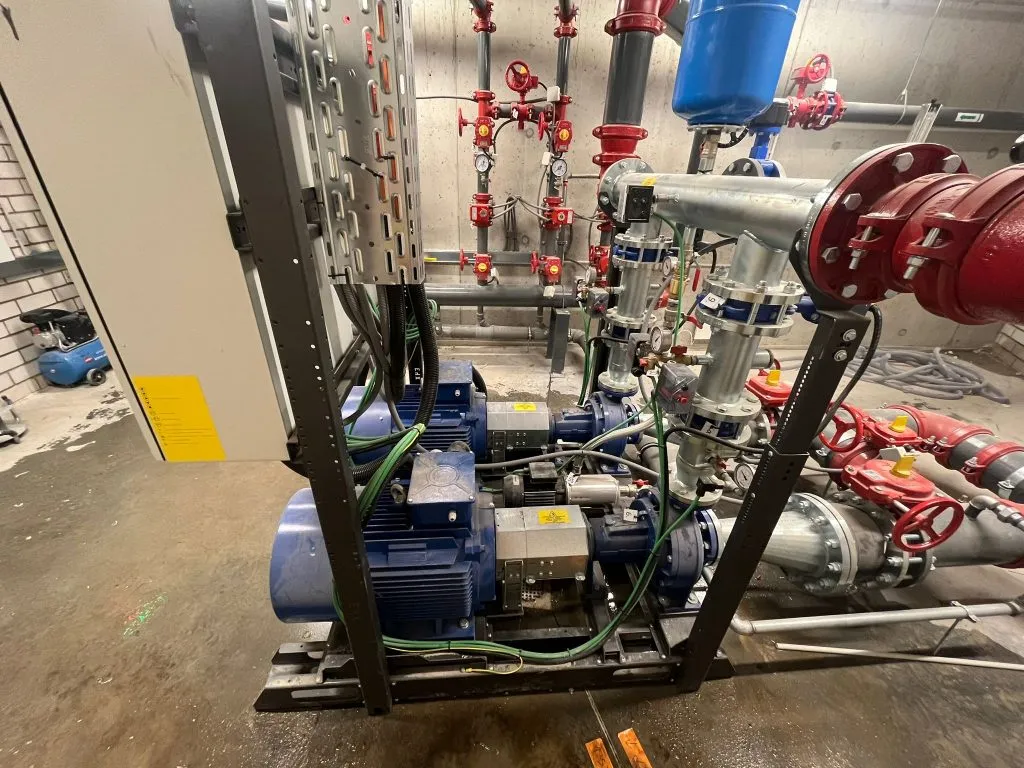
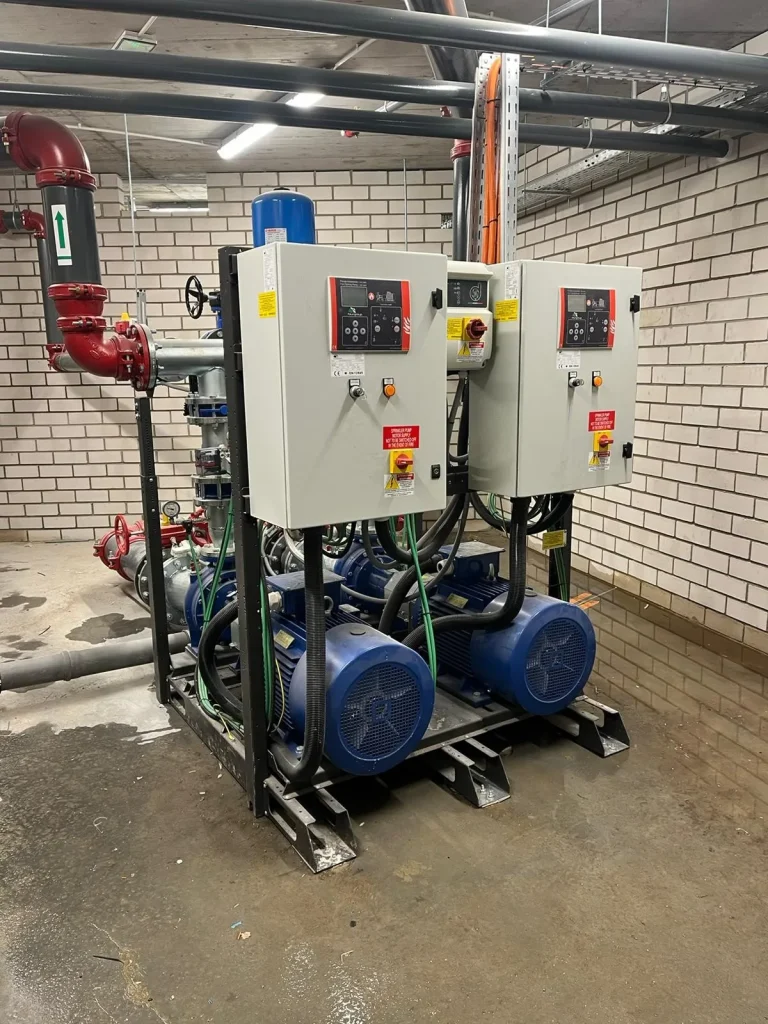
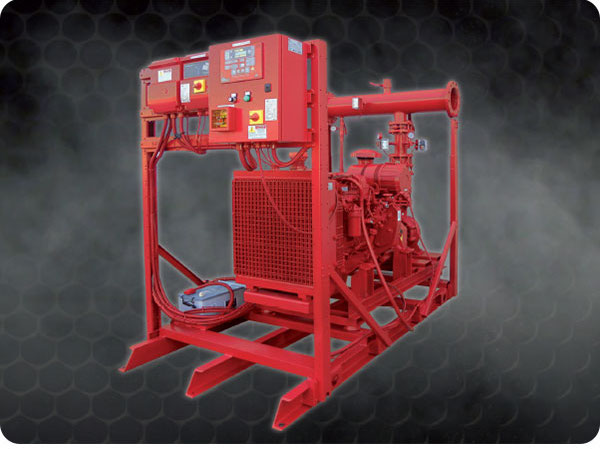
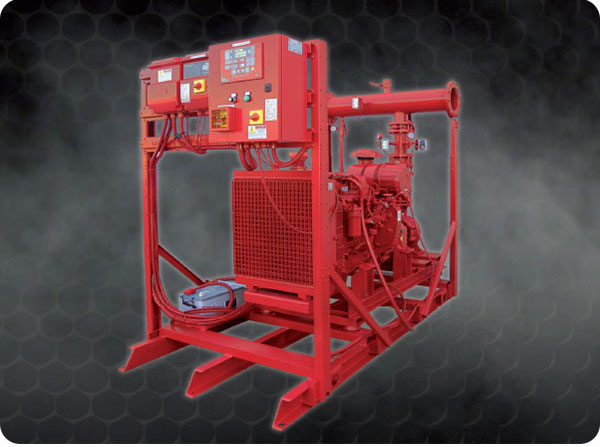
A typical fire fighting station consists of 1 or 2 autonomous engines driving centrifugal pumps, an auxiliary pressure maintenance pump and an automation control panel. If the main or backup pumps are driven by electricity or an internal combustion engine and are intended for work when it is necessary to create high water pressure in the event of an accident, then the electric pressure maintenance pump has another function – to ensure constant maintenance of the required pressure in the system. In this way, wear and tear on the main pump and automatic control panel is reduced, avoiding frequent switching on/off of the units. When the pressure drops, the electric pressure maintenance pump starts automatically and raises it to the required level again. In the event of a fire, the pressure maintenance pump is no longer able to maintain the required pressure in the system, it continues to drop, and in this case the main or backup fire pump starts, which ensures effective water supply to the sprinklers.

EN 12845 standard

Fire pumps installed in Europe must comply with the international EN 12845 standard – this is regulated by the 2016 Order of the Director of the Fire Protection and Rescue Department under the Ministry of the Interior On the Approval of the Rules for the Design and Installation of Stationary Fire Extinguishing Systems. This document also contains a complete list of conditions under which the installation of fixed fire extinguishing systems at the facility is mandatory.


A fire pump that complies with the standard (EN 12845) mentioned before has the following characteristics:

  • The fire fighting station starts automatically in the event of a fire – the control unit responds to a pressure drop in the system below a predetermined limit and automatically starts the electric or internal combustion engine that drives the pump;
  • Fire pumps are switched off manually;
  • The control automation panel constantly monitors the water pressure in the system and, if it drops below a predetermined limit, activates audible and visual warning signals and starts the pump;
  • Fire fighting stations are factory calibrated and tested – this allows a quick assembly and installation process at the facility;
  • The fire fighting station is equipped with a flow meter that allows measuring the performance of the station.

The EN 12845 standard defines the standards that a modern and efficient fire fighting station must meet. However, the mere fact that fire pumps comply with this standard does not guarantee that fire safety in a building will be properly ensured.

The most important parameters of a fire fighting station

It is extremely important to take certain parameters into account when designing and selecting a fire fighting station – the mere fact that the product complies with the EN 12845 standard is not enough.

The point of best efficiency

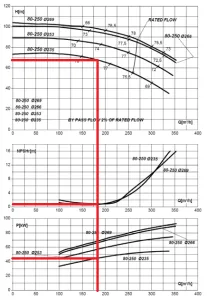
The operating point of a fire fighting station. The curve indicates the NPSH, power requirement and pressure generated (bar) at the corresponding capacity (m3/h)The point of best efficiency, sometimes also called the operating point, is the range of the pump operating curve in which the highest possible efficiency is achieved – pumping performance and pressure generated. When designing and installing a fire fightingp station, this is one of the most important parameters. Usually, such a point is reached in about 80 percent of time from the beginning of the pump’s operating curve. In order to select the most effective option, you need to know the following parameters – the fire fighting station’s performance, measured in cubic meters per hour or liters per minute, and the pressure generated, usually measured in meters of water column or bars.

Pump driving engines

Depending on the complexity of the project and safety requirements, professional fire fighting stations can be equipped with internal combustion or electric engines. There is also a choice between one and two engines and the pumps they drive. This not only determines the reliability of the fire fighting station in the event of a possible accident, but also its price.

The cheapest and most common option is an electric motor driving a fire pump. The most important condition for providing a pump with this type of engine is the electrical input to the facility, its power and reliability. Even if the facility has an electric generator to ensure the supply of electricity in the event of a power outage, a backup pump driven by an internal combustion engine can raise a fire alarm reliability to a better level.

Water supply to the fire fighting station

An equally important aspect is where the water supply to the fire pumps will be provided. The three most common options are: an above-ground reservoir, an underground reservoir or city water networks.

The configuration and price of fire pumps also depend on the water supply provided in the project. Depending on the supply, the NPSH (net positive suction head) indicator of the pump is selected, which defines the conditional hydraulic pressure.

Proper selection of this indicator allows you to avoid cavitation – a process during which water at the pump opening begins to evaporate and boil, thereby interrupting the flow of water and causing damage to the pump itself. There are two indicators: NPSHr and NPSHa, respectively indicating the pressure required by the pump at the suction opening and the actual water pressure that the system supplies to the pump suction hole. The most important thing is that the NPSHa indicator is higher than the NPSHr – only in this way will cavitation be avoided.

Fire fighting station design

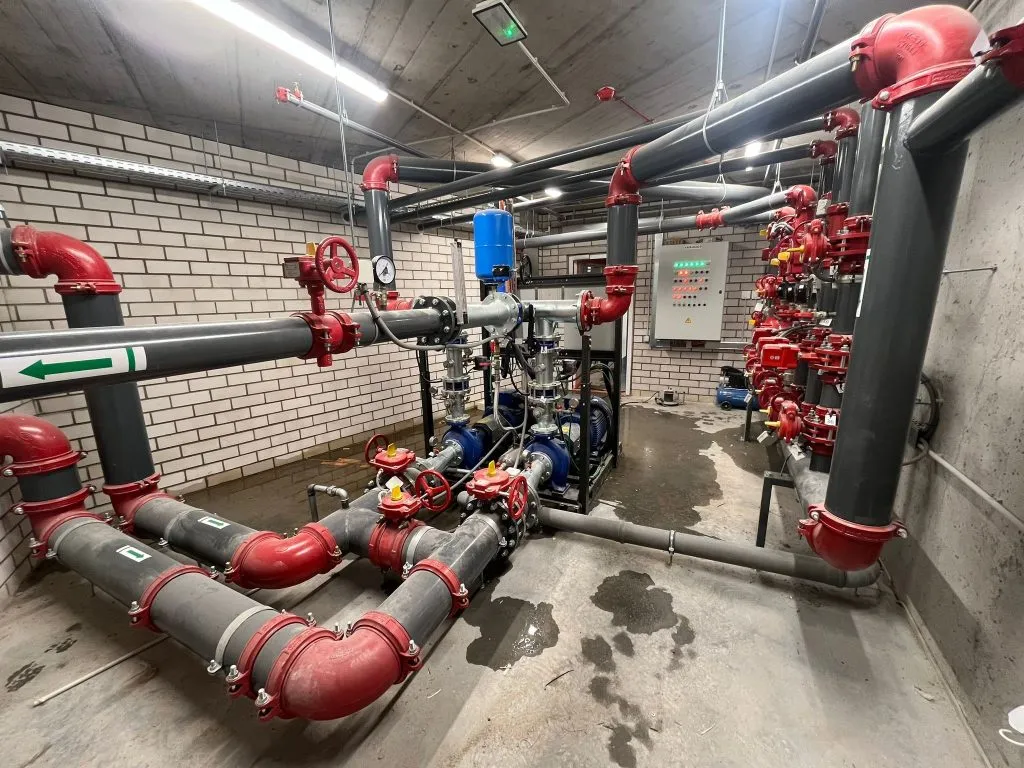
Fire pumps are mounted on a special metal frame, which allows for quick and convenient transportation of the entire station, its building and installation at the facility. Both the main and standby pumps (if provided for in the project) and the electric pressure maintenance pump can be mounted on the same structure.

Conditions of the implementation of the EN 12845 fire fighting station standard

Fire pumps must be installed in a room dedicated to this purpose, in a room that provides at least 60 minutes of fire protection. This can be a separate building, a building connected to the main building protected by fire sprinklers, or a separate room in a building protected by fire sprinklers. These rooms also have requirements for ambient temperature. If the installed fire pumps are driven by an electric motor, the ambient temperature in the room should not be lower than 4 °C, while if the pump is driven by a diesel engine, it is necessary to ensure a temperature of at least 10 °C. The room must also be adequately ventilated, which is especially relevant if fire pumps with a diesel engine are provided. The requirements that must be implemented to achieve proper ventilation of the room are provided by the fire fighting station manufacturer.

The requirement for the temperature of the water pumped by the fire fighting station is no more than 40 degrees Celsius. If a submersible pump is used, the water temperature is limited to 25 degrees, except in cases where the submersible pump is manufactured in accordance with the provisions of another standard (EN 122589-12) and is adapted to work with temperatures up to 40 degrees.

Shut-off valves must be provided in the fire fighting station installation on both the pressure and suction sides.

In order to ensure smooth water suction, it is important to follow the rules of positioning fire pumps. If a tank is used for water supply, at least 2/3 of it should be above the central axis of the pump. Also, this axis must be no lower than 2 meters above the lowest water point in the tank. Each fire pump must always be filled with water, and a separate, dedicated water tank is used for this task, the water level of which is maintained by a separate electric pressure maintenance pump.

Pressure sensors are responsible for the automatic start of the fire fighting station, which, having sensed a pressure drop in the system, automatically start the fire pump. The pipe to which the pressure sensor is connected should be at least 15 mm in diameter. If the fire fighting station consists of 2 separate pumps, the first pump automatically starts when the pressure in the system drops to 0.8*P, where P = system pressure with closed valves. The second pump starts when the pressure value drops to 0.6*P. The pumps operate until they are physically, manually switched off.

The power supply to the fire fighting station must be provided by a separate line, all cables must be resistant to fire and mechanical damage. The safety relays must withstand the increased load that occurs during engine start-up for at least 20 seconds.